In Loving Memory

Duke

🐾 2019 – 2024  ·  Forever my boy

My best friend for five short years. I lost him too soon — and to this day I believe it began with something almost no one warns you about. This is for Duke, and for every dog we can still protect.

Meet Duke

His Story

What happened to Duke

I brought Duke home when he was 16 weeks old — half American Bulldog, half Pit Bull Terrier, all heart. From that day on we were inseparable. I spent every single day with him. He wasn’t just my dog; he was my best friend.

He was perfect. Healthy, happy, five years old and full of life. Then he was sprayed — directly in the face — by a skunk.

Forty-eight hours later, my perfect, healthy dog had hypercalcemia — dangerously high calcium in his blood.

What followed was a blur of veterinarians and tests. I took him to three different vets. Every one of them told me the same thing: it had nothing to do with the skunk. But I knew my dog. He was perfect before that happened, and within two days everything changed. I kept saying it. I don’t think anyone really heard me.

Meanwhile, the visits and the tests went on — and whatever was actually wrong with him just lingered, untreated. He was eventually diagnosed with cancer. I started a GoFundMe and spent every penny I had trying to save him. I called in every favor I could. It wasn’t enough. Not long after, Duke was gone.

I can’t prove the skunk is what set it all in motion. No one could — and that’s part of what still haunts me. But I will always believe the timing was no coincidence. And I’ll always wonder what might have been different if even one person had taken that connection seriously instead of brushing it aside.

If Duke’s story makes one vet listen, or one owner push harder for answers, then he’s still doing what he always did — looking out for the people he loved.
The Warning

A skunking is a medical event —
not just a smell.

A direct spray to the face is not an odor problem. It is a toxic chemical assault — and its effects are delayed, surfacing hours to days later. Duke was perfect until that skunk. Forty-eight hours later, his body began to fail. We believe that was no coincidence — and the fact that no one would even investigate it is exactly why we built this page.

72

hours — the minimum a sprayed dog should be watched closely. But the danger doesn’t always stop there. (72-hour monitoring per the ASPCA Animal Poison Control Center)

0–3 hours

Drooling, squinting, red or swollen eyes, vomiting, face-rubbing. The obvious part — and where most people stop worrying.

3–24 hours

The thiols in skunk musk can begin destroying red blood cells — Heinz body anemia and methemoglobinemia. This is the silent, dangerous phase.

Up to 72 hours

Anemia can deepen. Without bloodwork and supportive care, a heavily-sprayed dog can crash. A documented case ended in a fatal seizure.

Days to weeks later

This is where we lost Duke. His blood calcium climbed, his body strained, and every vet looked everywhere except the skunk. What skunk toxin does over weeks has never been studied — and that void is where dogs slip away.

What we believe — and what no one would investigate

Duke went from perfect to fighting for his life in 48 hours, the moment a skunk sprayed him in the face. We are certain that skunk set it in motion. No one could prove it did — but no one could prove it didn’t, because no one was willing to look.

Signs to take seriously — call a vet now

Pale or brown gumsChocolate-tinged gums are a red alert — red blood cells are failing.
Dark or red urineCoffee- or blood-colored urine means cells are breaking down.
Excessive thirst & urinationSudden heavy drinking can signal rising calcium or kidney strain.
Appetite loss & weaknessNot eating, listless, or unwilling to get up.
Fast, heavy breathingPanting or labored breaths as oxygen runs low.
VomitingWorrying on its own — urgent alongside any sign here.

What to ask your vet for

If you remember one thing

After a heavy skunking, don’t wait for symptoms.
Ask for bloodwork — and watch your dog closely for 72 hours.

The Bigger Picture

Why the system failed him

Duke’s high blood calcium was called cancer. Since losing him, we’ve learned two things that keep us up at night — one about the medicine, one about the money. Neither is a conspiracy theory. Both are on the record.

1. A parasite can wear cancer’s face

When a dog’s body can’t clear a parasite or infection, it walls it off in a granuloma — a mass of immune cells that looks identical to a tumor on a scan. In dogs this is well documented: Spirocerca lupi is nicknamed “the carcinogenic nematode,” forming masses routinely mistaken for tumors; granulomas even mimic brain tumors on MRI.

And here is Duke’s exact picture: granulomatous and parasitic inflammation produces the same high-calcium bloodwork that cancer does. Immune cells inside a granuloma make active vitamin D in an unregulated way, pushing calcium up — a mechanism documented in dogs from parasites (angiostrongylosis, schistosomiasis) and infections (blastomycosis, pythiosis). Veterinary references note this kind of hypercalcemia is “most commonly caused by malignancy” — which is exactly why a mind jumps to cancer and stops looking.

The tests that tell a parasite from a tumor — calcitriol, PTHrP, infectious panels, a biopsy of the mass — are cheap. They were never run. That isn’t bad luck. That’s the trap.

2. Follow the money: who trains your vet?

The giants of the pet-food industry — Purina, Hill’s, Royal Canin — fund the nutrition centers, the residencies, the research, and the conferences that shape how veterinarians are educated, while formal nutrition gets only a few dozen hours in a four-year degree. This isn’t fringe: the American Veterinary Medical Association published a piece on it called “Learning Under the Influence,” and the World Small Animal Veterinary Association’s own nutrition committee warns that most pet-nutrition research is industry-funded and conflicts of interest should be declared.

We don’t believe most vets are villains — the ones who tried to help Duke were kind people. But we believe the system that trains them carries commercial fingerprints, and its incentives quietly reward lifelong management — prescription diets, recurring medications — over cheap prevention and root-cause answers. When the people teaching you profit from the products, the questions that don’t sell a product are the ones that go unasked.

Duke deserved a system more curious about the cause than comfortable with the label.

You are your dog’s only true advocate. Ask what your vet was taught — and who paid for it. Push for the test that wasn’t run. Get the second opinion. Trust what you know about your own animal. That is the lesson Duke paid for — and the reason this page exists.

Save Your Dog

The workup he deserved

If your dog ever has unexplained high blood calcium, this is the diagnostic protocol their own profession publishes. Ask for every step by name. These are the tests that tell a curable parasite or infection from a death sentence — and Duke never got them.

  1. 1
    Confirm it — measure ionized calcium. Total calcium can mislead. Repeat it fasted and measure the ionized fraction — the number that actually matters.
  2. 2
    The hormone panel — PTH, PTHrP + ionized calcium, together. A “normal” PTH alongside high calcium is itself abnormal. High PTHrP leans toward cancer — but it is not always raised, so a normal result does not mean stop looking.
  3. 3
    The vitamin-D panel — calcidiol + calcitriol. ★ the one that finds a treatable cause. High calcitriol points to a granuloma, infection, parasite, or vitamin-D poisoning — not typical cancer. Skip it and you skip the answer.
  4. 4
    Imaging — chest x-rays + abdominal ultrasound. Hunt for masses, enlarged lymph nodes, stones. A granuloma and a tumor look identical here — which is exactly why the next step is non-negotiable.
  5. 5
    Don’t stop at “looks normal.” The protocol says aspirate the lymph nodes, spleen, and liver even if they seem normal, and check bone marrow even if the blood count is fine. “Nothing obvious” is not a diagnosis.
  6. 6
    Biopsy the mass. No exceptions. No dog gets labeled “cancer” without cancer cells confirmed under a microscope. A scan is a suspicion. Cells are proof.
  7. 7
    Rule out the great pretenders. Addison’s disease (an ACTH-stimulation test), vitamin-D toxicity (rodenticide or a supplement), and kidney disease all raise calcium — and all are missable.

If you take away three things

PTHrP · the calcitriol / vitamin-D panel · a biopsy

Those three separate a curable parasite or infection from terminal cancer. They are cheap. They are routine. Demand them before you accept any verdict.

No dog should be handed a death sentence without the tests that could have found a cure. That’s the standard of care — in their own words. Print this. Take it to your vet. Don’t leave without answers.
— for Duke, and for yours.

Protocol per the Merck Veterinary Manual, Today’s Veterinary Practice, and VET.CT. This is educational, not veterinary advice — always work with a vet you trust.

First 10 Minutes

If your dog gets sprayed

Decontaminate fast and correctly — then start the clock on watching them.

1

Keep them outside

Don’t let a soaked, skunky dog into the house — the musk spreads to everything and keeps off-gassing.

2

Mix it fresh

Use the peroxide formula below. Plain soap, water, or tomato juice will not neutralize the oils.

3

Flush the eyes

Rinse eyes gently with cool, clean water. Avoid getting the peroxide mix in or near the eyes.

4

Then watch — 72 hours

Check the gums and urine. Any sign on the list above → vet immediately. Don’t wait it out.

The de-skunk formula

The chemist’s recipe (Krebaum) — it oxidizes the smelly oils into odorless, rinsable compounds.

  • 1 quart fresh 3% hydrogen peroxide
  • ¼ cup baking soda
  • 1–2 tsp liquid dish soap
  • For big dogs, add 1 quart of warm water

Work it deep into the fur, leave 5 minutes, rinse thoroughly. Repeat if needed.

Important

• Mix it fresh and use it right away. Never seal it in a closed container — pressure builds and it can burst.

• Keep it out of eyes, nose, and mouth.

• It may lightly bleach fur and fabric.

• A dog that smells skunky again after drying is still releasing toxins — keep rinsing.

Protect Your Dog

Duke’s lesson, turned into action

We can’t change what happened to Duke. We can make sure his story leaves you better prepared than we were.

🌿

Feed a clean diet

Whole, minimally-processed food and fresh water support a dog’s defenses. Cut the fillers, junk, and known toxins. A strong, resilient body is better armed against whatever it meets.

🌙

Skunk-proof the yard

Skunks roam at dawn and dusk. Secure trash, close off gaps under decks and sheds, add motion lights, and leash up for low-light walks. Don’t give a skunk the opening.

🩺

Know the signs

Brown gums, dark urine, heavy thirst, sudden weakness — at any point after an encounter. Save your emergency vet and poison-control numbers now, not in a panic later.

📣

Advocate — loudly

You know your dog better than anyone. If something changes and you’re brushed off, push back, write down the timeline, and get a second opinion. Be the voice they don’t have.

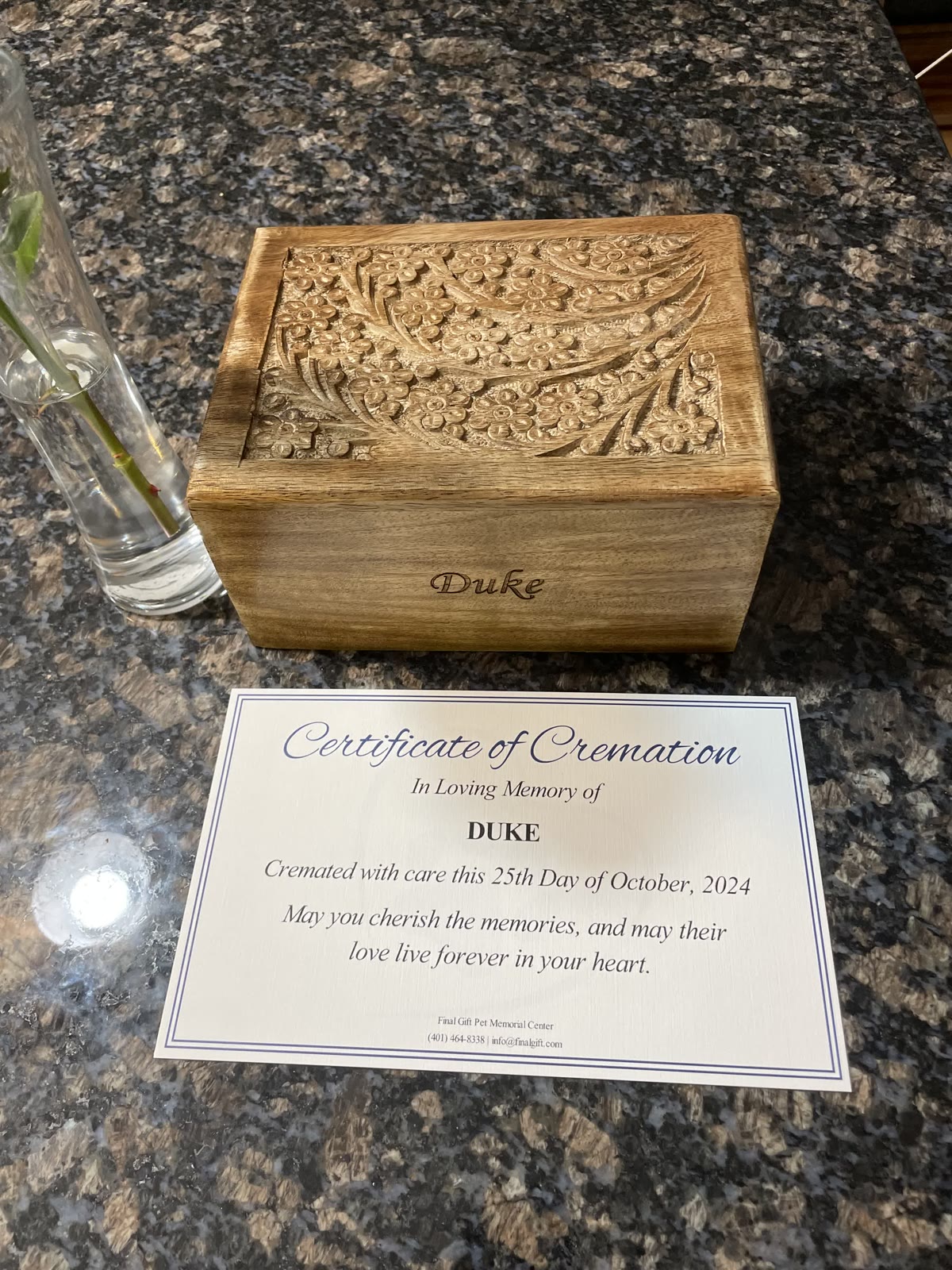
Duke’s engraved urn and Certificate of Cremation, dated October 25, 2024.

Remember

Good boy. Always.

Duke didn’t get the chance he should have had. We can’t change that. But if his story makes one owner act faster, ask the right question, or refuse to be brushed off — then Duke is still looking out for the pack.

Share his story. Tell a friend with a dog. That’s how he keeps saving them.